链接: https://neodb.social/book/5xCnITToUrNF6bqUykU3G8
作者的输出方式 #card
- 電子報:每日發行,持續十三年
- Facebook:每日更新,持續八年
- YouTube:每日更新,持續五年
- 寫作:每日三小時以上,持續十一年
- 出版:每年平均二至三本,連續十年
- 新作講座:每個月兩場以上,連續九年
为什么要做输出?#card
- 我曾經做過一項實驗,針對三十個讀過暢銷一百七十萬冊的《被討厭的勇氣》的人提出問題:「請解釋阿德勒心理學的定義。」其中能夠完整回答出來的,只有三個人,僅僅只有一成。其餘大多數的人一句話也答不上來,說不出個所以然。[[@被讨厌的勇气]]
输入输出的黄金比例 3:7 #card
- 根據一項針對大學生念書時間當中,「輸入」(念課本)和「輸出」(解題)各自時間佔比的調查發現,輸入和輸出的比例平均大約是7:3。
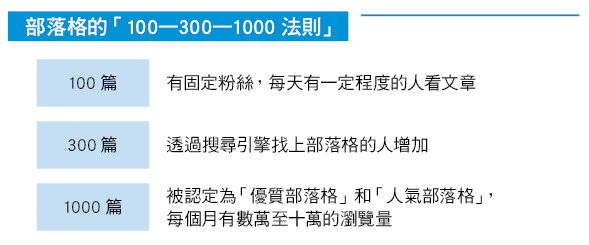
博客文章的 [[100-300-1000法则]] #card
- 具体
- 超过 100 篇,每天都会有固定的人来看博客。
- 超过 300 篇,文章会出现在搜索引擎结果的前几页,有越来越多的人透过搜索引擎找到你的博客。
- 超过 1000 篇,显示在搜索引擎结果第一页的文章会越来越多,每个月可以达到数万至数十万浏览量以上的点击。
- 成为注目的交点至少必须维持三年才行(一天一篇文章=1000篇文章)
通过 「Before」+「After」框架写读后感 [[how to read a book]] #card
- Before:写读书之前有什么疑惑、困扰
- After:读完书如何解决你的疑惑、困扰
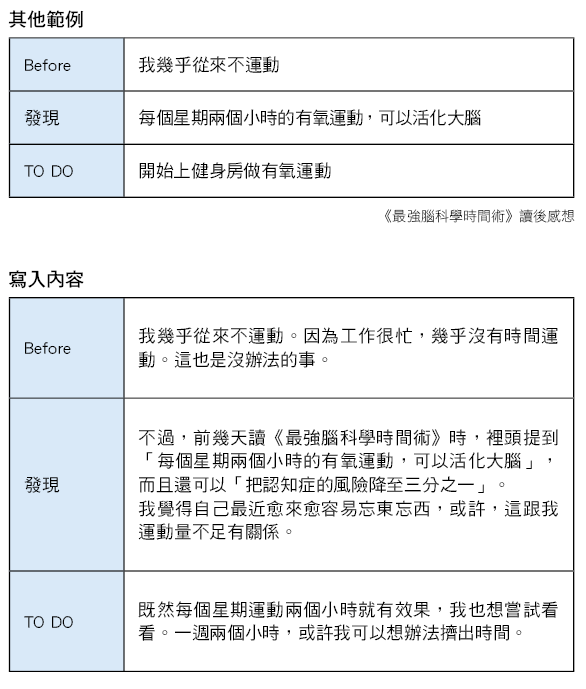
- 进一步拆分成「发现」+「TO DO」,接下来通过实践去获得自我成长
通过 「Before」+「After」框架写读后感 例子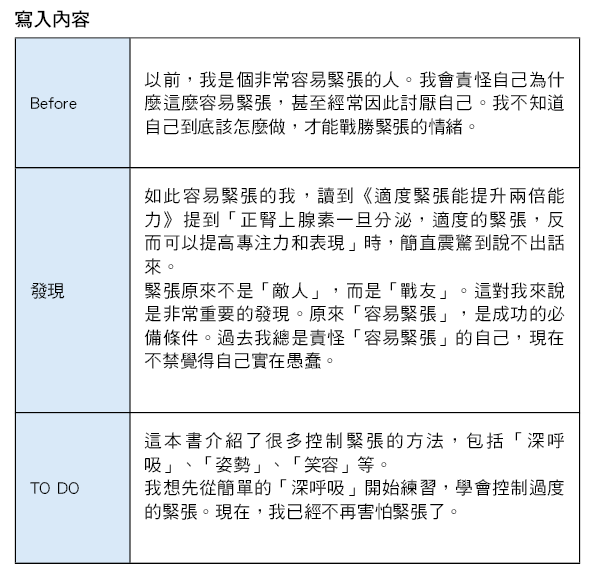
Ref
- [[最高學以致用法 (highlights)]]
@TabNet: Attentive Interpretable Tabular Learning
[[Abstract]]
- We propose a novel high-performance and interpretable canonical deep tabular data learning architecture, TabNet. TabNet uses sequential attention to choose which features to reason from at each decision step, enabling interpretability and more efficient learning as the learning capacity is used for the most salient features. We demonstrate that TabNet outperforms other neural network and decision tree variants on a wide range of non-performance-saturated tabular datasets and yields interpretable feature attributions plus insights into the global model behavior. Finally, for the first time to our knowledge, we demonstrate self-supervised learning for tabular data, significantly improving performance with unsupervised representation learning when unlabeled data is abundant.
[[Attachments]]
- TabNet_2019_Arik_Pfister.pdf {{zotero-linked-file “TabNet_2019_Arik_Pfister.pdf”}}