@A Tour Through My Zettelkasten

启发

  • 按类型给 tag 分配颜色

sobjornstad/tzk: Zettelkasten edition and tooling for TiddlyWiki (github.com) 作者工作流对应的 [[TiddlyWiki]] 模板

Organizational principles

  • 所有 tiddler 使用驼峰法命名
  • 通过 Links 关键相同主题的 idea
  • tags 使用不同的背景颜色区分不同的功能
    • Indexes, as per Luhmann (green)
    • Classifiers of publicity status (black) 是否公开
    • Lists of things, as per TW understanding of tags (blue) 主题聚合
    • Create different types of tiddlers and pseudo-types (red, orange)
      • Source 信息来源
      • PAO(Person, Animal, or Organization)
      • Places
      • Tool
    • Identify areas to work on – Stub, 需要拆分 NeedsExcision, etc. (yellow) 需要继续完成的
  • Index tiddlers 关于某个主题的总览
  • Stretchtext and description transclusion 提供关于笔记的摘要,供聚合使用
  • Subtiddlers 类似于 logseq 的namespace,另外一种形式聚合方式。
  • Bibliographies 关于特定主题参考内容的聚合字段
    • tiddler 中字段 Bibliographies 填上材料对应的主题
    • description 提供内容摘要
  • Write 当前需要继续完成的内容
    • stubs
    • misssing
    • needing attention 需要处理的内容
    • todo-item 包含 todo 的集合
    • open question
  • Reference Explorer 展示和当前 tiddler 关联的 backlink、link,提供按 tags 过滤
    • 列出关联的 link 也很重要
  • link graph 通过 TiddlyMap 层次化展示当前 tiddler 关联的其他 tiddler

Types

  • ((77648bc4-a0fd-4e8f-833c-0ed106a315e4))

[[Plugin]]

  • CodeMirror vim 模式
  • Details widget 页面聚合插件
  • Relink 改名自动更新引用
  • Stretchtext
  • TiddlyTables 表格
  • Tidgraph
  • Triple-click to edit
  • [[TiddlyRemember]] anki 制卡工具

隐私开关

  • 隐私块通过新建 tiddler 实现,同时需要隐藏标题
  • 编译脚本根据公开的 tiddler 新建 publish 版本

ReadingInbox 管理和安排待阅读的材料

  • Source pasting 粘贴向导,记录资源

SimpleAnalytics 网页访问信息分析脚本

Tag coloration and columnizing 实现按颜色对标签进行排序

Philosophy 笔记关联方法背后对应的哲学

  • JustGetStarted 无压力记录想法,区分完成的笔记和没有完成的笔记
  • ThreeLinks

@How to Take Smart Notes

Highlights

  • We just seem to happen to read the publications that tend to confirm what we already know.
  • Richard Feynman once had a visitor in his office, a historian who wanted to interview him. When he spotted Feynman’s notebooks, he said how delighted he was to see such “wonderful records of Feynman’s thinking.” “No, no!” Feynman protested. “They aren’t a record of my thinking process. They are my thinking process. I actually did the work on the paper.” “Well,” the historian said, “the work was done in your head, but the record of it is still here.” “No, it’s not a record, not really. It’s working. You have to work on paper, and this is the paper.”[33] This, obviously, was a very important distinction to Feynman, much more than just a linguistic difference – and for a good reason: It is the distinction that makes all the difference when it comes to thinking. Philosophers, neuroscientists, educators and psychologists like to disagree in many different aspects on how the brain works. But they no longer disagree when it comes to the need for external scaffolding. Almost all agree nowadays that real thinking requires some kind of externalization, especially in the form of writing. “Notes on paper, or on a computer screen […] do not make contemporary physics or other kinds of intellectual endeavour easier, they make it possible” is one of the key takeaways in a contemporary handbook of neuroscientists (Levy 2011, 290) Concluding the discussions in this book, Levy writes: “In any case, no matter how internal processes are implemented, insofar as thinkers are genuinely concerned with what enables human beings to perform the spectacular intellectual feats exhibited in science and other areas of systematic enquiry, as well as in the arts, they need to understand the extent to which the mind is reliant upon external scaffolding.”

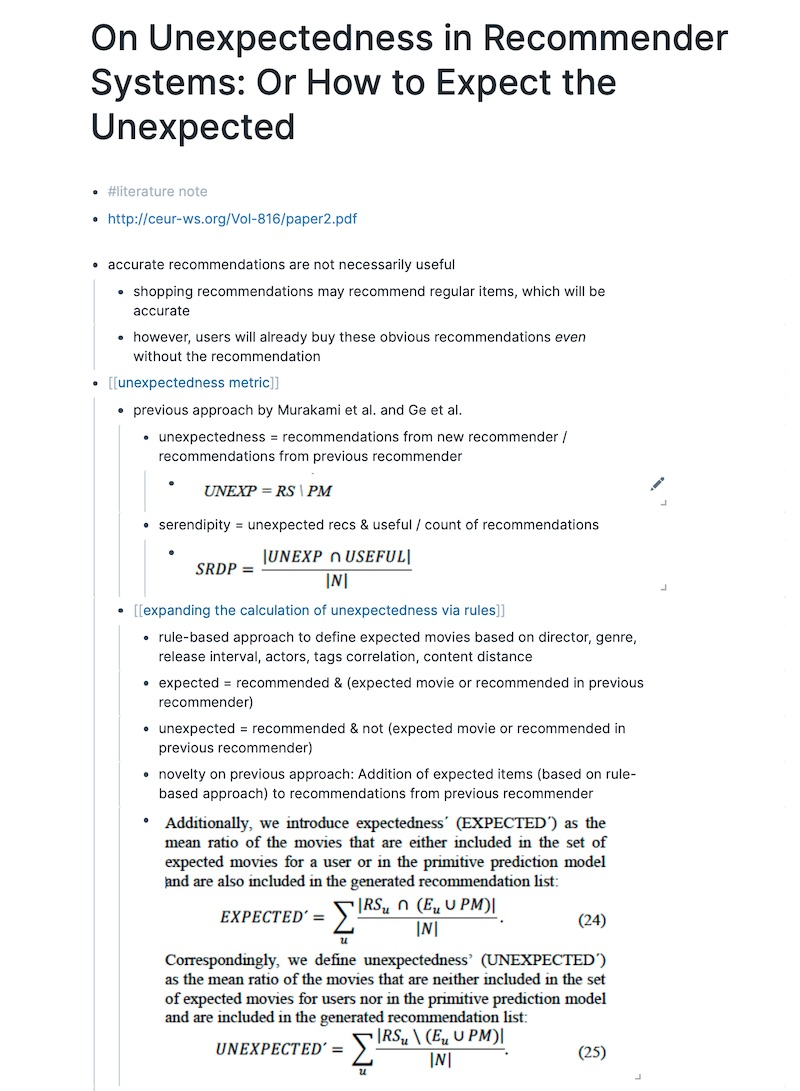
Literature note

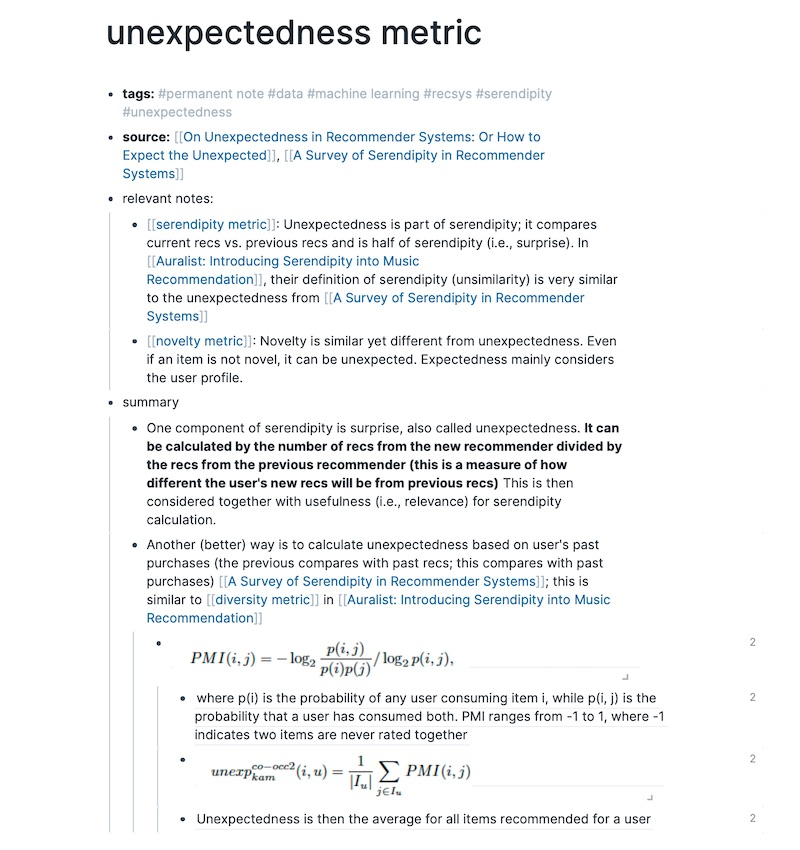
Permanent note

卡片盒的价值

Ref


Stop Taking Regular Notes Use a Zettelkasten Instead

Here’s how a Zettelkasten works:

  • Write each idea you come across on a card
  • Link idea cards to other relevant idea cards (idea -> idea link)
  • Sort cards into broader topic boxes (idea -> topic link)

Literature notes

  • Add useful docs (papers, books) as a literature note
  • Metadata includes: literaturenote tag, source, author
  • Summarise content, each key idea as a simple sentence
  • Elaborate on each key idea with some bullet points

Permanent notes

  • 写 Permanent notes 的两条标准
    • Would I explore this further?
    • Or can I connect this to other ideas?
  • Permanent notes 的 metadata
    • permanentnote tag
    • topic tags
    • Source,literature note link
    • relevant permanent notes and short explanation of how it is relevant
    • Add summary in prose

Topics

  • This comes free if you’ve been adding topic tags
  • You can now jump into topics via tags and navigate via links of relevant permanent notes

具体实践可以参考

+