@Part II: Personal Memory Systems More Broadly
两个问题
- how important is {{c1 memory}} as a {{c2 cognitive skill}}?
- what is the role of {{c1 [[cognitive science]]}} in {{c2 building personal memory systems}}?
How important is long-term memory, anyway?
- “rote memory” 比理解更低级?
- memory is the foundation of our {{c1 cognition}}
- My somewhat pious belief was that if people focused more on {{c1 remembering the basics}}, and worried less about {{c1 the “difficult” high-level issues}}, they’d find the high-level issues took care of themselves.
- I now believe {{c1 memory of the basics}} is often the single largest barrier to understanding
- 熟悉新领域基础知识有助于理解
- Adriaan de Groot and [[Herbert A. Simon]] studying how people acquire expertise, focusing particularly on chess
- They found that world-class chess experts saw the board differently to beginners. 大师和新手看到的棋盘不一样
- A beginner would see “a pawn here, a rook there”, and so on, a series of {{c1 individual}} pieces.
- Masters, by contrast, saw much more elaborate “ {{c1 chunks}} ”: combinations of pieces that they recognized as a unit, and were able to reason about at a higher level of abstraction than the individual pieces.
- 有关国际象棋大师和新手的区别:专家拥有更加复杂的 chunks
- Simon estimated chess masters learn between {{c1 25,000 and 100,000}} of these chunks during their training, and that learning the chunks was a key element in becoming a first-rate chess player. Such players really see chess positions very differently from beginners.
- [[@刻意练习]]里面也要提到过
- George Miller 论文 The Magical Number Seven, Plus or Minus Two,提出 {{c1 chunks}} was effectively the basic unit of working memory
- They found that world-class chess experts saw the board differently to beginners. 大师和新手看到的棋盘不一样
- distributed practice meaning → practice which is distributed in time
- Hermann Ebbinghaus
- Ebbinghaus forgetting curve 遗忘曲线
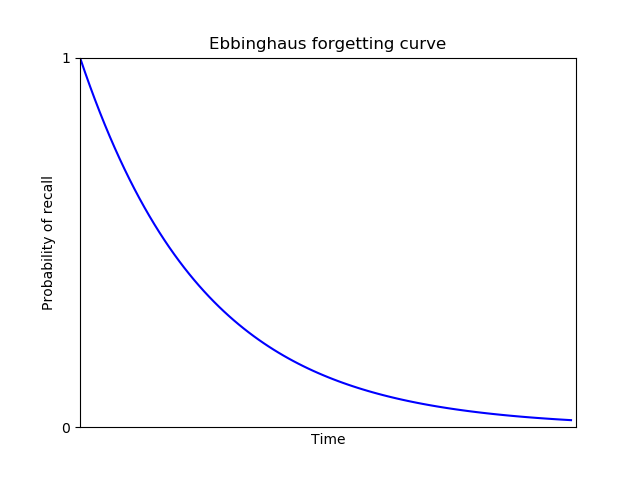
On the role of cognitive science in the design of systems to augment cognition
- they show emphatically that {{c1 distributed}} practice outperforms {{c2 massed}} practice
- 反例子:某些技能在一定时间后会增强
- we learn to swim during the winter and to skate during the summer.
- an 1895 study of Axel Oehrn
- {{c2 memory is complicated}}, we don’t understand many of the big picture questions well, and we should {{c1 be careful}} before we put too much faith in any given model.
- memory is complicated 还需要时间去理解相关的内容
- 如何在理论不完善的背景下,开始设计系统?
@Part II: Personal Memory Systems More Broadly