@the concept-descriptor note taking technique
Remnote 创始人 [[Martin Schneider]] 使用 [[Concept-Descriptor Framework]] 理念,搭配软件做的笔记的方法。相同方法他在 twitter 和 youtube 上发了很多版本,大差不差。另外提一句,Remnote 的颜值在一众笔记软件中是数一数二的。
想法
- Martin 在 twitter 上介绍已经写了 500000 rem(相当于logseq中的block)以及超过 40000 张卡片([[20230428]])
- 可以通过 [[logseq-anki-sync]] 实现 [[在 logseq 中实践 CDF]]
摘录
Martin Schneider:“How to take notes and actually remember what you learn: I’ve used this for over 40,000 cards
- Organize your notes around concepts.
- Notes to Flashcards And active recall
- Add new idea to concept
- Add images
- Link your source material
Understand Anything in 5 Steps
- “Complex” ideas aren’t necessarily any harder to understand than “simpler” ones; they’re often just larger and harder to detangle.
- Understanding any idea is a repeated process of breaking the idea into smaller components until you get to “mind-sized bites”.
- 具体流程
- Find Important Names ↔ Every time you hear a new concept, write down its name.
- Add Definitions ↔ Define your concepts with a precise statement that captures the core of the idea.
- Ask Questions ↔ Expand your understanding of each concept by writing questions that add details.
- Organize With Hierarchy ↔ Break down complex ideas by hierarchically nesting them into smaller components.
Move questions under the concepts they’re describing.
+ Use it & Iterate ↔ Apply your knowledge on exams, practice problems, life, etc! Find where it’s wrong, and update your notes
生物学例子
- 原始材料
- All cells share four common components: 1) a plasma membrane, an outer covering that separates the cell’s interior from its surrounding environment; 2) cytoplasm, consisting of a jelly-like cytosol within the cell in which there are other cellular components; 3) DNA, the cell’s genetic material; and, 4) ribosomes, which synthesize proteins.
- 写下重要的名词
- plasma membrane
- cytoplasm
- DNA
- ribosomes
- 写下对名词的理解
- 原始材料
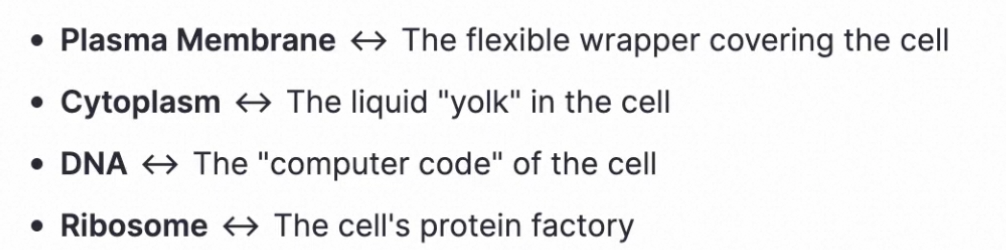
+ 写出问题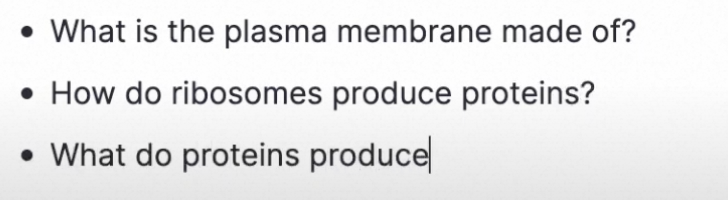
+ 将所有的名称和问题通过层次化的方法组织,持续并反复迭代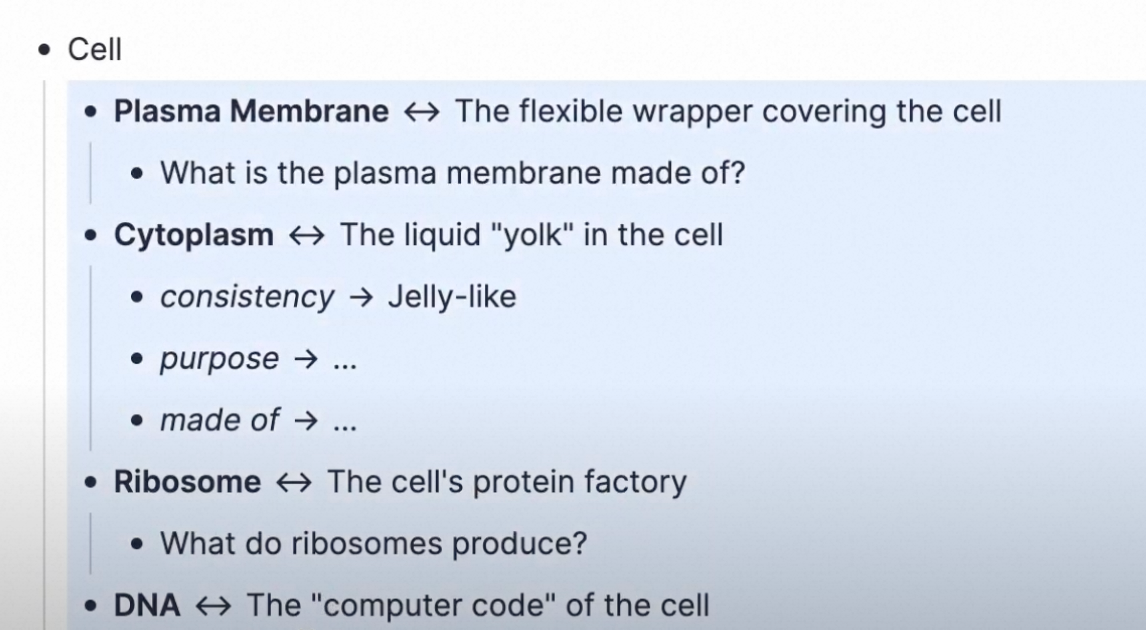
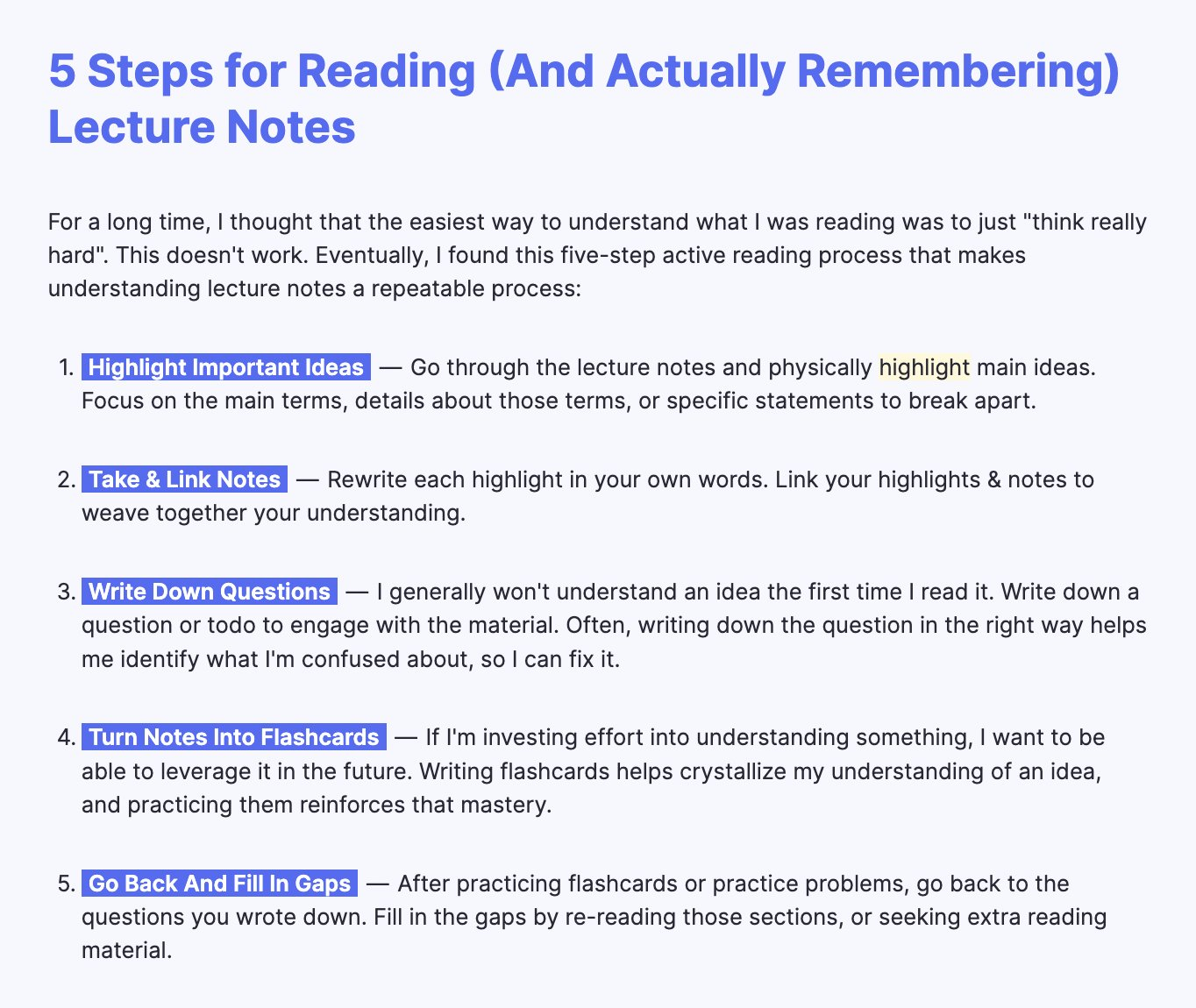
@the concept-descriptor note taking technique