9a - note synthesis
课程链接: [[@Magical Academic Note Taking]]
想法
- Note Synthesis 可以理解成笔记整理,从 What 、Why、When 三个角度出发,沿着 The Lagger of Thought 一级一级整理出可以支持你后续创作的笔记。在 [[8D - The Building BLOCKS - Block Types]] 中作者介绍她自己的笔记体系,这节课通过实际的例子讲解如何使用不同类型的笔记标签。
Pre-Synthesize
- 打开对应的材料 page
- 打开需要整理的笔记页面(一本书/一篇论文的全部高亮)
- 浏览浏览导入的高亮引用,标注关键词,将主题移到到 Topic 页面
- 写总结 Executive Summary,告诉未来的自己,这篇材料的主要内容是什么。
- 浏览导入的高亮引用,标注关键词,将主题移到到 Topic 页面
- 总结 Executive Summary,告诉未来的自己,这篇材料的主要内容是什么。
Synthesize
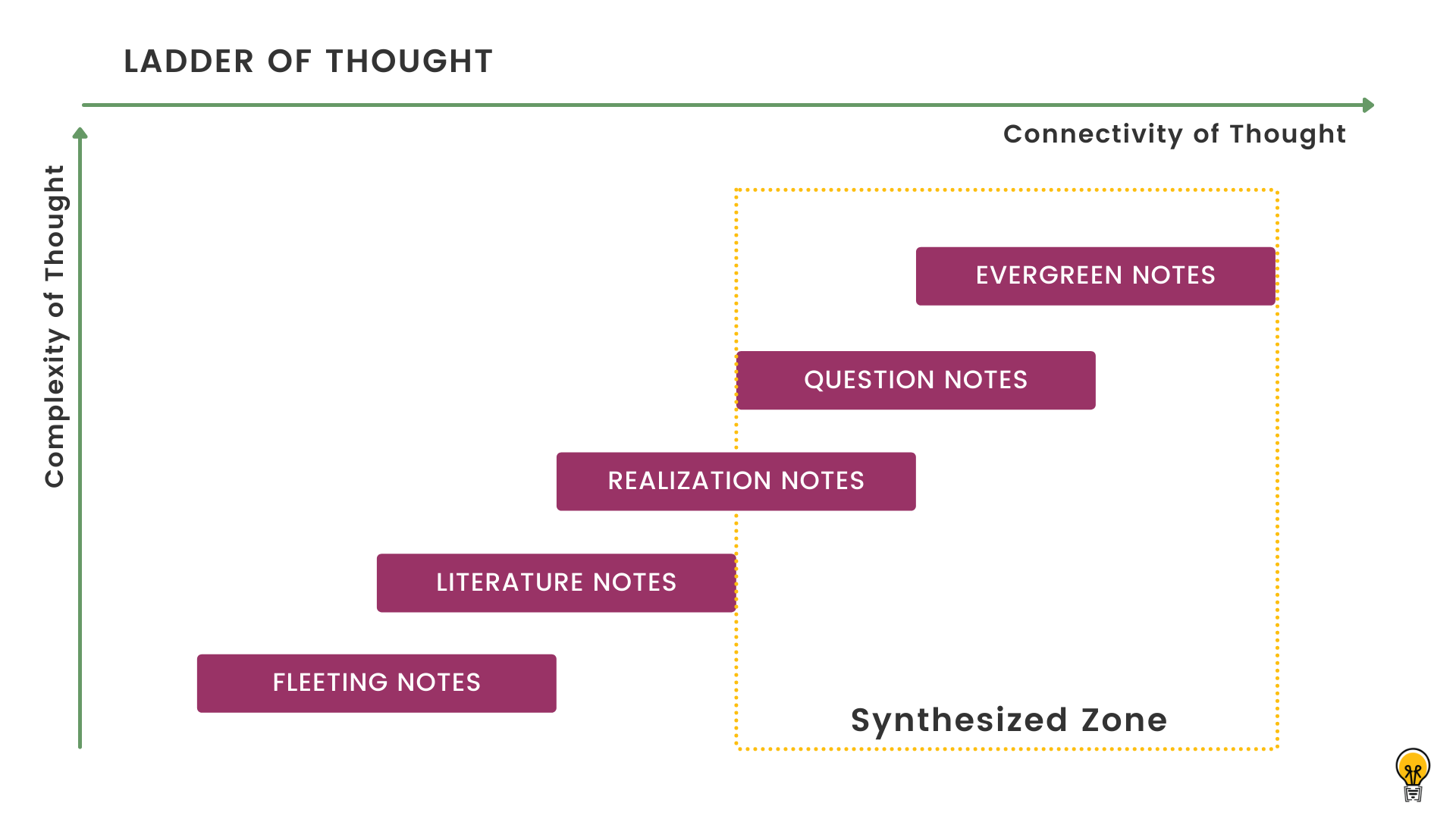
+ 如何组织笔记:Classify、Clarify、Connect
+ 从 Classify、Clarify、Connect 三个方面整理笔记
Classify (What?)
- [[Fleeting Notes]]
- [[F-Note]] are used within your academic writing as direct quotes with attribution. → 在您的学术写作中用作带有出处的直接引用。
- [[F-Note]] notes are the initial notes collected from a source. → F-Note 是直接摘录的原始笔记
- [[F-Note]] are always the words and ideas of others (direct quotes or copied content). → 其他人的文字和想法
- [[F-Note]] should never be used without attribution to the source material. → 不应该在没有标注来源的情况下使用
- As part of the X - Collect process, an [[F-Note]] will have a sub-bullet that will represent a thought the reader had while consuming that specific content.#card
- F-Note 有一个子节点,记录读者在阅读对应内容时的想法
- Fleeting Notes are the bottom layer of the foundation for further thinking. → 闪念笔记是进一步思考的基础。
- Also known as Fleeting Notes, Context Snippets. [[F-Note]]s support → 别名
- [[Literature notes]] 用自己的话重写 fleeting notes 的内容
- [[L-Note]] are used within your academic writing as paraphrases with attribution. → 带有归属的释义
- [[L-Note]] are a simple re-statement of the original text in the [[F-Note]] in your own words. → 用自己的话总结 F-Note
- In the process of creating Literature Notes it is essential that the reader just simply re-states and does not permit the influence of their personal worldview, theories, or pre-conceived ideas. → 文献笔记只需要重写原文,而不要融入自己的世界观、理论或设想
- Literature Notes serve two main purposes #card
- They facilitate a deeper understanding of the material 更深入理解材料
- They ensure that you do not change the meaning of the text from its original context. 保证你不改变原来的含义
- Requiring an [[L-Note]] prior to further analysis of the Fleeting Note also allows the writer to easily see where they are adding value to their reading. → 重新阅读产生什么价值
- If the writer has something to say beyond the simple re-statement in an [[L-Note]] an [[R-Note]] is required. → 如果在重写 L-Note 时还有其他想法想写,需要一个 R-Note
- An [[L-Note]] may uncover a new [[Q-Note]] required to explore an idea further. → L-Note 可能引发出一个 Q-Note
- [[Literature Note 例子]]
- [[Realization Notes]] #card
- 为什么要写下这个笔记?
- SyncRead
- R-note 更进一步的想法
- Q-note 需要大量 blocks 支撑(实验、观点),Q-note 记录你不确定的东西。
- [[Fleeting Notes]]
Q-note 会变成未来论文的标题、章节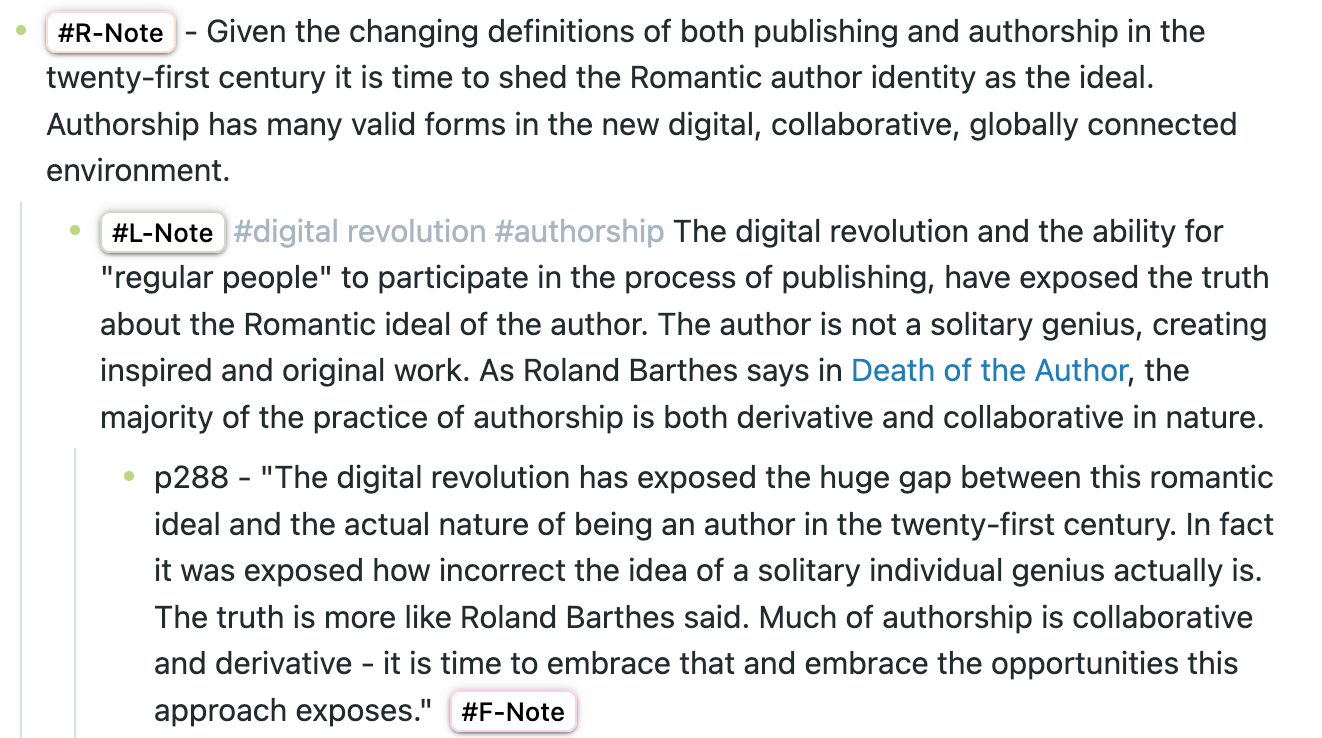
+ 常青笔记围绕一个主题记录,
+ 思想阶梯,记录一个想法从产生到成熟。
+ Z-note 一个页面,个人对一个主题所有理解。
Clarify (Why?)
- Question Notes
- Q-note 需要大量 blocks 支撑(实验、观点),Q-note 记录你不确定的东西。
- What
- ((67df9421-2076-465a-9edb-10b3fab7426d))
- Example #card
- Question Notes
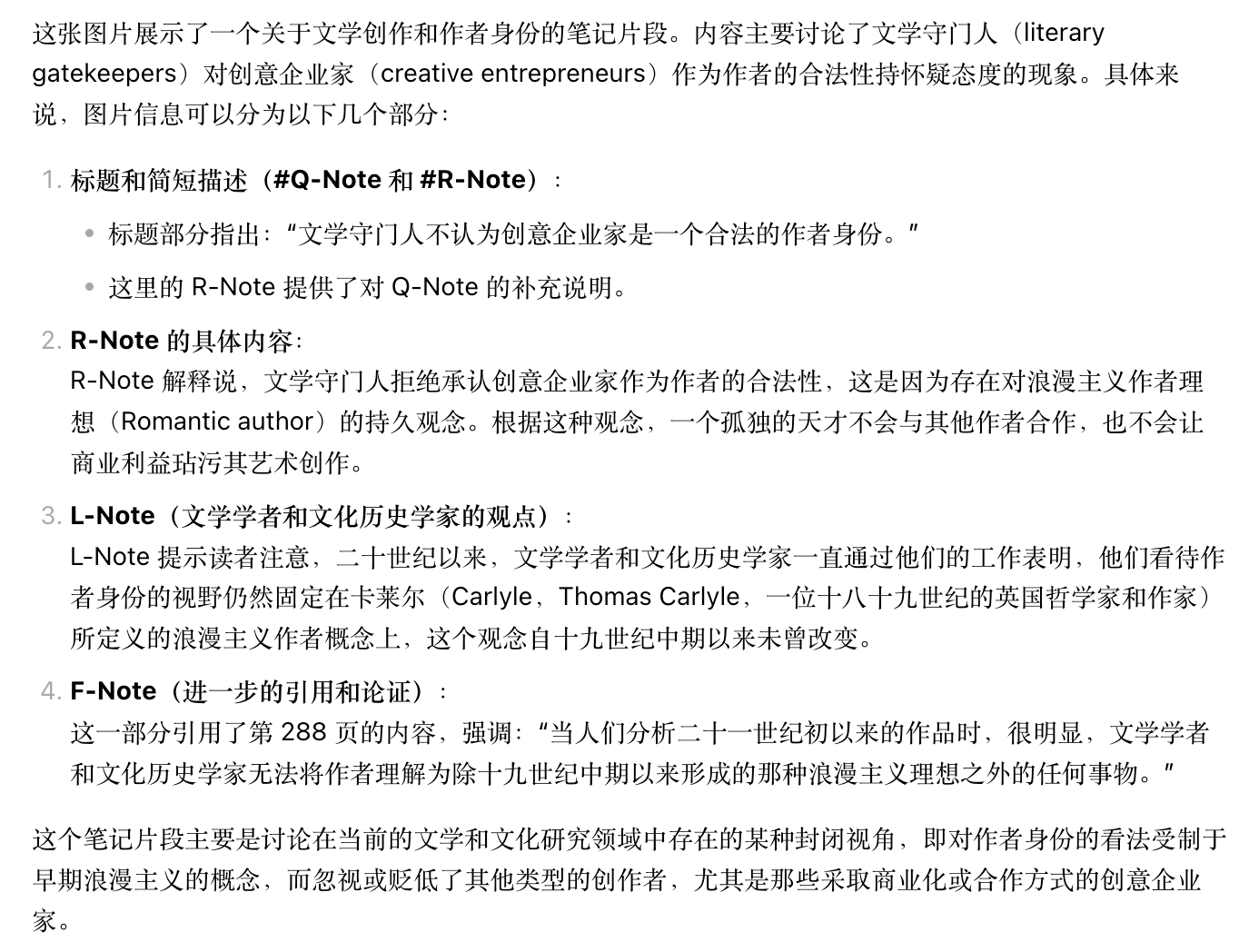
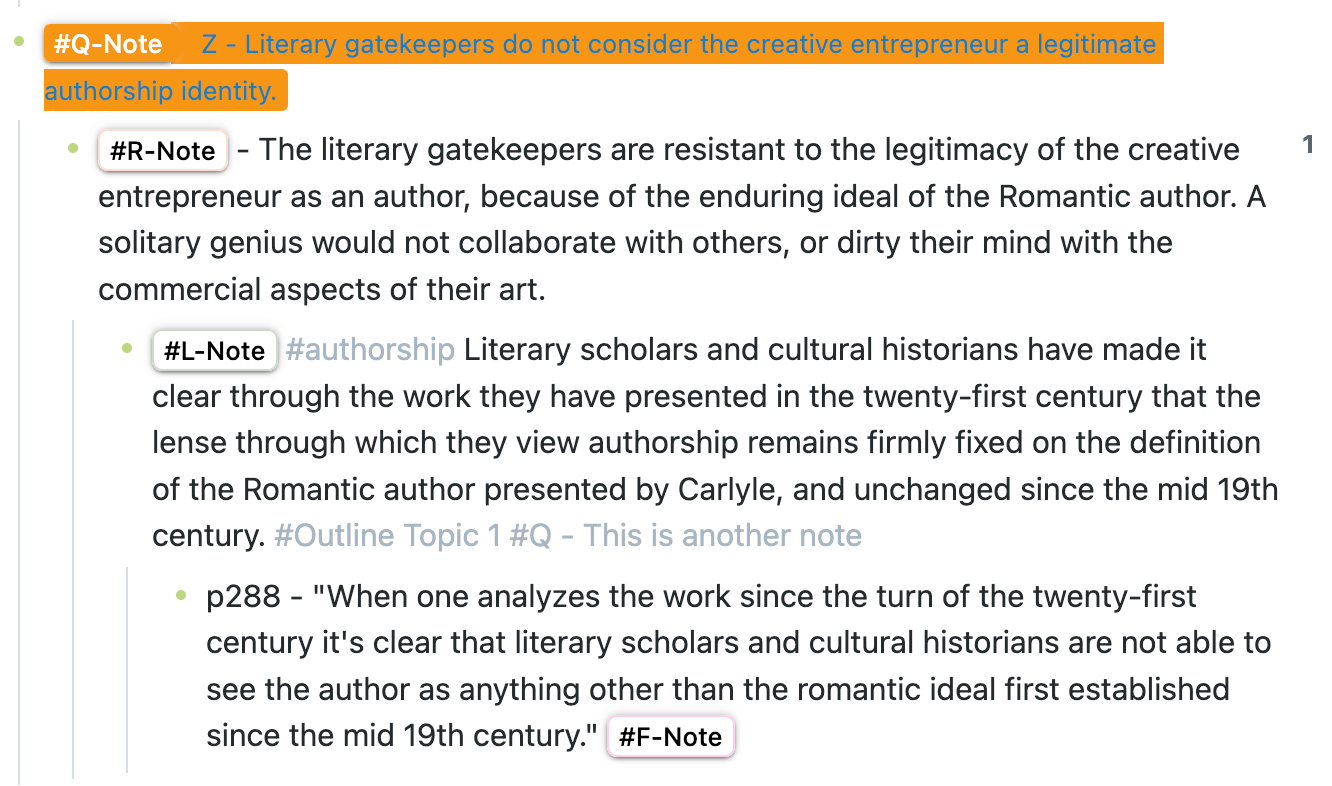
+ Evergreen Notes/Synthesis Notes/Zettelkasten/[[Permanent Notes]],对某个特定主题的理解
+ What
+ ((67df946e-e624-484b-a6d1-e2df145c658c))
+ example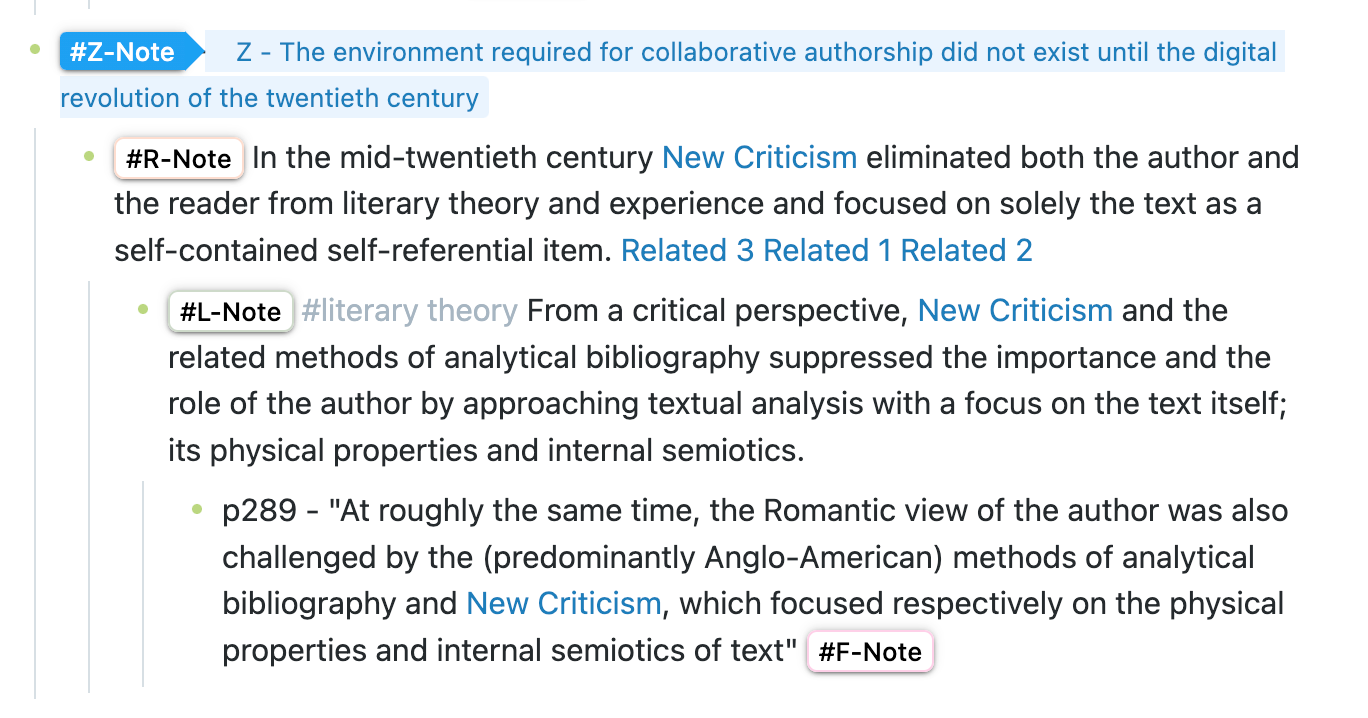
+ Z-note → 解释说,在二十世纪的数字革命之前,协作创作为作者所必须的环境环境尚不存在。这个论点暗示了一场文化和技术革命彻底改变了文学创作的生态。
+ R-Note 这部分指出, → 二十世纪中期,**“新批评”(New Criticism)**这个文学潮流,将作者和读者从文学理论和经验中排除在外。根据新批评的理论,文章应被视为一个自给自足、自成体系的实体,他们的研究仅专注于文本本身,而不考虑其它因素。
+ L-Note 提到 → 从评论的角度来看,新批评和分析书目等方法强调对文本本身的探讨,关注其物理特性与文本的内部标志学 (internal semiotics)。虽未直接与协作创作相关的直接信息,但其表明作者在这些领域的不同研究视角。
+ F-Note → 引用了第289页的内容,指出了上述背景中的具体实例。这段文字表明,随着新批评和分析书目方法的相继出现,以作者个人为中心的浪漫主义观点遭遇了挑战。这部分内容强调了新批评和分析书目方法对物理属性和文本内部标志学的强调,与作者观点相拼争。
Connect/Time-Travel (When?)
- 高亮的内容放在对应的 page 下面,
- Ways to Travel through Time
- Very Important #card
- On Page
- On Page 通过页面汇总相关的 block
- Important #card
- Tagging - Page Level
- Nested Under Page Backlink - Page Level
- Nested Under Page Backlink - Page Level 嵌套在页面的反向链接下面
- Related Referencing - Block Level
[]()相关引用 - Related Referencing - Block Level
[]()
- Less Important #card
- All Blocks to a Page
- Very Important #card
- Keeping it clean #card
- Commenting (also useful during create session)
- Invisibility Cloak, Roam 插件
- Commenting (also will be useful when we get to writing)
Post-Synthesize
- Ideas Remix 组合不同的想法形成新的想法?
Ref
- Joel Chan’s [[@knowledge synthesis]]
9a - note synthesis
https://blog.xiang578.com/note/magical_academic_note_taking_9a.html